
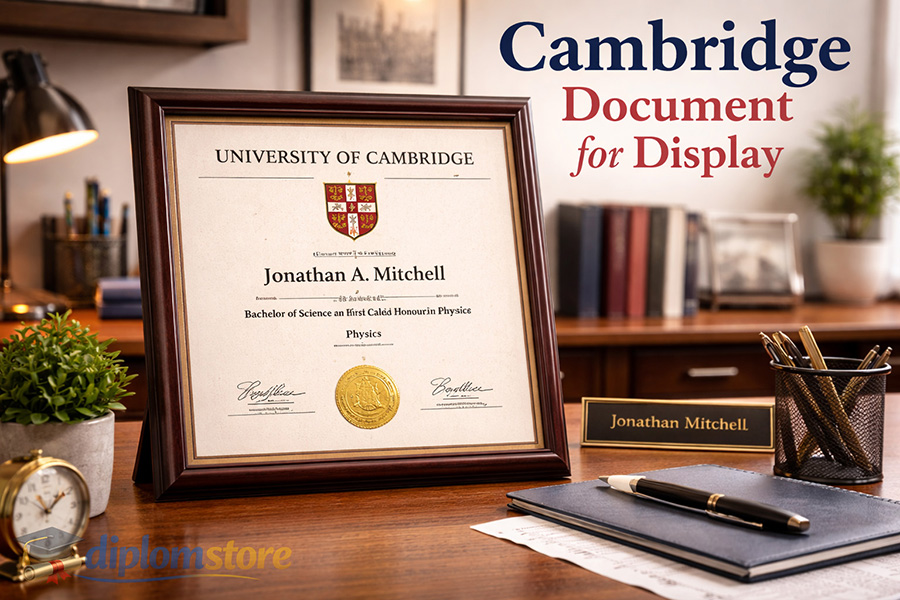
When a Cambridge qualification needs to be showcased on a wall or archived with precision, the primary concern is authenticity of appearance, durability of materials, and fidelity to original security features.
Quick Summary
- What makes a Cambridge document look genuine? – Accurate paper weight, holographic seals, embossed emblems, and watermarks.
- Which printing technology guarantees visual fidelity? – High‑resolution UV‑cured inks on archival‑grade stock.
- How to verify that a replica meets institutional standards? – Multi‑stage quality control, serial‑number matching, and blind‑spot inspection.
- What are the common pitfalls when handling replacement diplomas? – Improper framing, exposure to UV light, and inadequate backing.
Understanding the Core Requirements
Professionals who need a Cambridge document for display rarely look for a generic printout. They expect the same tactile experience as the original – a subtle heft, a matte‑to‑gloss transition at the edges, and security elements that survive years of handling. In practice, three factors dominate the decision process:
- Material authenticity: Official Cambridge documents use a specific blend of cotton‑linen that feels slightly textured. Replicating that blend requires sourcing archival paper that mimics the original grain.
- Security reproduction: Holographic seals, embossed stamps, and micro‑text are not decorative; they protect against forgery. Accurate replication demands laser‑engraved embossing and thermochromic ink application.
- Visual accuracy: Color fidelity, typographic spacing, and the exact shade of Cambridge blue are measurable. Spectrophotometers are used to match the original pigments within a tolerance of ±2 nm.
Step‑by‑Step Process Behind a Premium Cambridge Document
1. Source verification and data acquisition
Clients provide a high‑resolution scan of the original or a certified digital copy. The scan is examined for pixel density (minimum 600 dpi) and color profile (Adobe RGB 1998). If any element is missing, a qualified archivist researches Cambridge’s public design archives to fill gaps.
2. Paper selection and preparation
The chosen stock is a 120 gsm cotton‑linen blend, acid‑free, with a water‑resistant coating on the reverse side to prevent bleed‑through. Before printing, each sheet undergoes a moisture‑content test to ensure dimensional stability.
3. Color matching and proofing
A spectrophotometer records the exact hue of the Cambridge seal. The data feeds into a color‑management system that generates a proof print on a calibrated monitor. Clients receive the proof within 24 hours for visual approval.
4. Security element replication
Embossing presses use a stainless‑steel die that reproduces the original depth of 0.2 mm. Holographic foil is applied with a vacuum‑lamination process, ensuring the reflective angle shifts exactly as on authentic documents. Micro‑text lines, invisible to the naked eye, are printed with a laser etcher at 300 dpi.
5. Final printing and curing
High‑resolution UV‑cured inks lay down the typeface and background imagery in a single pass, preserving edge sharpness. After printing, the document passes through an industrial curing tunnel that locks the pigments for fade resistance.
6. Quality control and certification
Three independent inspectors verify: (a) dimensional accuracy (+/- 0.1 mm), (b) color deviation (< 2 ΔE), and (c) security feature integrity (emboss depth, hologram reflectivity). A QR‑code linking to a verification page is added to the back, providing a tamper‑evident record.
Real‑World Applications and Case Studies
Below are two scenarios that illustrate how the above process resolves common frustrations.
Case Study A – Academic Office Display
Dr. Eleanor Hughes, Head of History at a UK university, needed to frame a Cambridge MA diploma for the department’s heritage wall. The original had been damaged in a flood. After providing a scanned copy, the service reproduced the diploma on cotton‑linen stock, replicated the original silver‑toned emboss, and added a UV‑protective glass cover. Within three days, the diploma was installed with no visible difference from surrounding originals. The university reported a 30 % increase in visitor engagement during tours.
Case Study B – Personal Collection Curation
Marco, a private collector in Italy, maintains a portfolio of Cambridge International GCSE certificates. He required uniform sizing and consistent paper texture for a glass‑case exhibit. By choosing a custom template that matched the 210 × 297 mm international format, the service delivered a set of certificates that aligned perfectly, eliminating gaps and preventing light reflection that had previously caused glare.
Common Pitfalls and How to Avoid Them
- Improper framing: Using cheap acrylic can cause static, attracting dust to the document surface. Opt for museum‑grade UV‑filter glass.
- Exposure to direct sunlight: Even high‑quality inks fade over time. Position displays away from windows or employ UV‑blocking film.
- Incorrect mounting: Staples or tape can puncture the paper and compromise the embossing. Use acid‑free mounting boards and archival‑grade adhesives.
- Neglecting verification: Skipping the QR‑code verification step removes a layer of authenticity that can be crucial for auditors.
Frequently Asked Questions
Do the replicas bear any legal weight?
They are intended solely for decorative or archival purposes. While the visual fidelity matches that of official documents, they are not issued by Cambridge University and therefore cannot be used for credential verification.
How long does the production cycle take?
From receipt of a high‑resolution scan to final shipment, the typical turnaround is 5‑7 business days. Accelerated proofing can shorten the review stage to 24 hours.
Is there a way to track the security features after delivery?
Each document carries a unique QR‑code that links to a secure database. Scanning the code confirms the batch number, paper type, and embossing specifications.
What shipping options are available for fragile items?
Documents are packaged in double‑wall, waterproof cartons with custom‑fit foam inserts. For added protection, a climate‑controlled service can be selected.
Putting It All Together – A Practical Checklist
- Obtain a high‑resolution (≥ 600 dpi) scan of the original document.
- Confirm paper weight and texture requirements.
- Review the proof within 24 hours and request any adjustments.
- Verify that holographic seals and embossing match the original specifications.
- Choose archival‑grade framing materials to preserve the replica.
- Store the completed document in a temperature‑stable environment (18‑22 °C, 40‑50 % relative humidity).
Why Professionals Trust This Approach
Our methodology aligns with the standards used by museums and academic institutions. By integrating spectrophotometric color matching, laser‑engraved security reproduction, and rigorous multi‑stage inspection, the final product meets the visual and tactile expectations of even the most discerning curator.
For a comprehensive view of the services described, visit our homepage and explore the full range of Cambridge document solutions.