
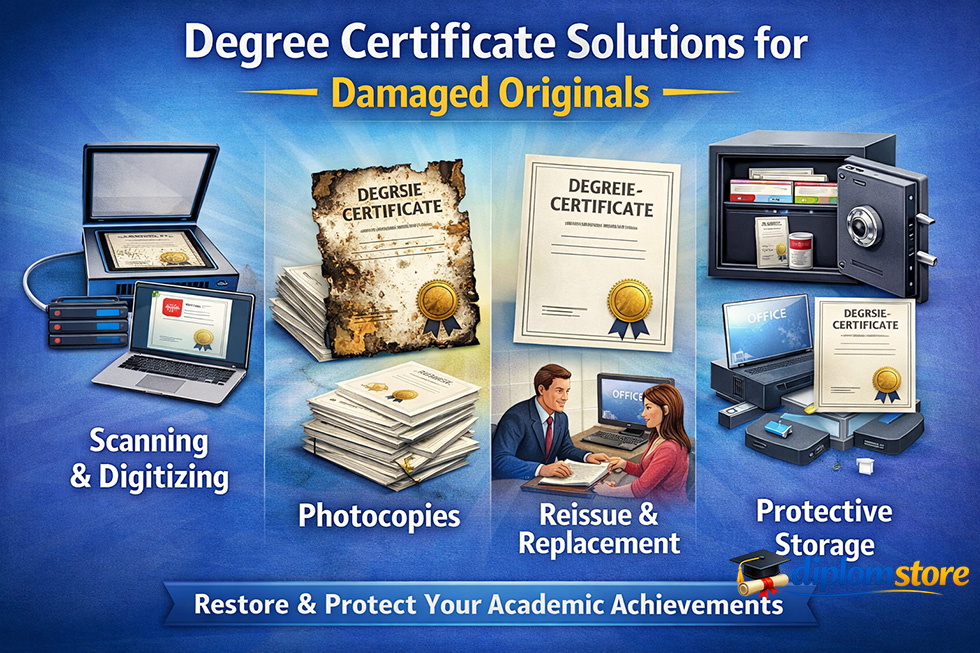
When a degree certificate is torn, water‑stained, or faded, the immediate concern is how to retain its official appearance and security features without compromising authenticity.
Why a Backup Strategy Matters
Most graduates treat their diplomas as memorabilia, yet the same document often serves as proof for visa applications, job interviews, or credential verification. A single flaw can trigger a request for a replacement, delaying processes by weeks. The most effective way to avoid that bottleneck is to create a reliable backup before any damage occurs.
Common Causes of Damage
- Exposure to moisture during relocation or storage.
- Improper framing that presses the paper against glass.
- Frequent handling during exhibitions or alumni events.
- Accidental cuts or tears from moving boxes.
Legal Perspective
In many jurisdictions, a certified replica is acceptable for personal display but not for official verification. Understanding the distinction helps you decide when a backup is merely decorative and when it must meet strict security standards.
Step‑by‑Step Backup Process
Below is a workflow that balances fidelity with practicality.
1. Document Assessment
Start by cataloguing the original’s dimensions, paper type, and visible security elements (watermarks, embossed seals, serial numbers). High‑resolution photos from a 300 dpi scanner capture texture and color nuances better than a smartphone camera.
2. Secure Digital Archiving
Store the scanned image in at least two locations: an encrypted cloud folder and an offline, password‑protected external drive. Use lossless formats such as TIFF or PNG to avoid compression artifacts.
3. Choosing the Right Reproduction Medium
For display purposes, archival‑grade cotton‑based paper (150‑200 gsm) reproduces the heft of most university diplomas. If the replica may be examined for security features, request a holographic foil overlay and UV‑reactive ink that mirrors the original’s anti‑counterfeit measures.
4. Professional Printing vs. In‑House Production
Professional services provide calibrated color profiles, press‑tested inks, and embossing equipment that are difficult to replicate with standard office printers. When using a specialized provider, verify their ISO‑9001 certification and request a sample proof before the final run.
5. Authentication Documentation
Attach a notarized statement describing the reproduction process, materials used, and the purpose of the copy. This document can be presented alongside the replica during informal verifications.
6. Physical Protection
Encapsulate the finished replica in a Mylar sleeve with UV‑blocking properties, then store it in a climate‑controlled cabinet. Avoid direct sunlight and fluctuations in humidity.
Case Studies
Case A: Engineering Graduate, 2015
After a flood damaged the original diploma, the graduate used a pre‑existing digital archive to produce a high‑fidelity replica. The replica included a UV‑visible seal identical to the university’s original. Within three days, the employer accepted the replica for background checks, citing the notarized authentication document. The total cost was 30 % lower than ordering an official re‑issue from the university.
Case B: International Student, 2021
A student applying for a work visa in Europe discovered that the embassy required a clear view of the diploma’s embossed seal. The student’s backup plan involved a laminated copy with a holographic overlay sourced from a certified printing firm. The embassy confirmed the copy’s acceptability, and the visa was granted without delay.
Quick FAQ (Featured Snippet Ready)
Q: How often should I update my digital backup?
A: Every 2–3 years, or immediately after any change in the document’s condition.
Q: Can a replica be used for official purposes?
A: Generally, only the original issued by the institution is legally binding. However, a certified replica may be accepted for non‑critical verification when accompanied by notarized authentication.
Q: What security features are essential to replicate?
A: Watermarks, holographic seals, embossed logos, and serial numbers are the most scrutinized elements.
Q: Is there a risk of the replica being mistaken for a forgery?
A: Proper documentation and clear labeling as a “replica for personal use” eliminate most concerns.
Risk Management and Cost Considerations
Investing in a high‑quality backup eliminates the hidden costs of delayed job offers, visa rejections, or repeated archival requests. A typical professional replica ranges from $80 to $250 depending on security features, while DIY methods may reduce material costs but increase the risk of inaccurate reproduction.
Actionable Checklist
- Scan the original at 600 dpi using a flatbed scanner.
- Store the file in encrypted cloud and offline locations.
- Choose archival paper and verify the printer’s ability to reproduce security elements.
- Request a proof before final printing.
- Obtain a notarized statement describing the replication process.
- Encapsulate the replica in UV‑protected sleeve and store in climate‑controlled conditions.
Conclusion and Next Steps
Protecting an academic credential starts with awareness. By following the steps outlined above, you can ensure that a damaged original never becomes a roadblock to career or educational goals. For additional guidance, templates, and vetted printing partners, visit our home page and explore the resources tailored to each type of diploma or transcript.